
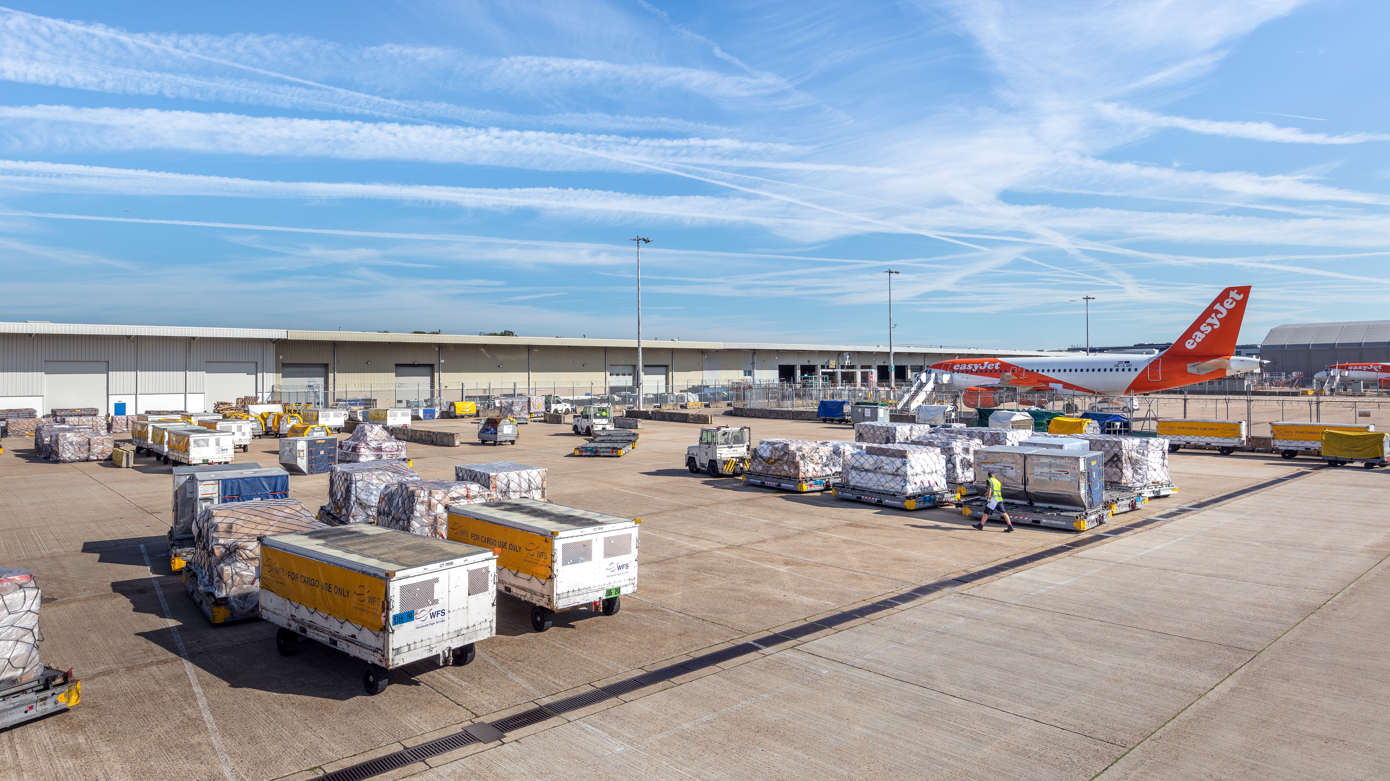
London Gatwick secures long-term boost for freight growth across the South East
- London Gatwick has acquired control of the on-airport World Cargo Centre
- The 1,747 sqm site plays a central role in freight handling at the airport
- London Gatwick’s Northern Runway plans will increase imports through the airport, generating 35,000 new jobs and adding £2bn to the economy every year
London Gatwick has taken a significant step to strengthening the resilience and long‑term growth of freight across the South East by acquiring control of the World Cargo Centre.
The move brings one of London Gatwick’s most strategically important cargo locations fully under the airport’s operational control, helping safeguard the infrastructure that underpins international trade through the airport.
The 1,747 sqm World Cargo Centre sits immediately alongside the airfield and plays a central role in how freight moves smoothly through the airport.
Most freight currently handled at London Gatwick travels in the hold of long‑haul passenger aircraft, particularly serving key markets in Asia, Africa and the Middle East.
By fully integrating the site into its operational estate, London Gatwick is ensuring these vital trade routes can continue to support UK businesses reliably and efficiently, while enabling future airfield investment linked to its Northern Runway programme.
Jonathan Pollard, Chief Commercial Officer, London Gatwick said: “Freight is a crucial part of how London Gatwick supports trade and economic growth across the South East and beyond. Bringing the World Cargo Centre fully into our estate secures the infrastructure that already keeps goods moving, strengthens resilience, and ensures we are ready to support future growth - while maintaining continuity for the businesses operating on site.”
The extension of London Gatwick’s cargo estate comes as demand for air freight continues to grow.
Government approval of plans to bring the airport’s Northern Runway into routine use alongside its Main Runway last September, will support up to 389,000 flights a year and increase cargo volumes to 161,500 tonnes by the late 2030s.
Independent analysis by Oxford Economics shows the value of imported cargo through London Gatwick to the UK economy could reach £9.8bn a year by 2038, more than twice the 2019 level and £2.1bn higher than would be achieved without the Northern Runway.
Freight growth is also forecast to support 167,500 jobs across the UK by 2038, an increase of 35,500 roles compared with no expansion.
London Gatwick commissioned two independent studies to assess the economic benefits of the Northern Runway proposals, including the volume and value of increased cargo capacity.
The Local Impact Assessment prepared by Oxera shows that by bringing the Northern Runway into routine use, London Gatwick will enhance the crucial economic role it plays by injecting £1bn into the regional economy every year, supporting 14,000 new jobs.
Separate analysis by Oxford Economics explores and forecasts the wider economic benefits created by tourism, connectivity and trade. Both sets of analysis are outlined in the Development Consent Order documentation that can be found on the Planning Inspectorate website .
With the Northern Runway in routine use, the volume of imports would more than double between 2019 and 2047, to 174,200 tonnes. These imports would facilitate £10.59bn of GVA and 160,400 jobs in 2047 once multiplier effects are included, around 20% higher than the equivalent activity facilitated in the Base Case. (Oxford Economics – numbers baseline plus NRP).
With around 43m annual passengers, London Gatwick is the UK’s second largest and one of Europe’s top airports. It is a vital piece of national infrastructure that drives both the national and regional economies by generating £5.5bn GVA and supporting over 76,000 jobs (2023). More than 60 airlines fly from the airport to over 160 short-haul and more than 50 long-haul destinations. With a declared maximum capacity of 57 movements an hour, London Gatwick is the most efficient single runway airport in the world.
The airport is located 28 miles south of the UK capital and is extremely well-connected, with more than a quarter of England’s population (15m people) – including all of London – less than one hour away by road or rail. A six-year, £2bn sustainable growth programme includes an ambitious plan to be a net zero airport by 2030 and to increase capacity by bringing the airport’s existing Northern Runway into routine use, alongside its Main Runway. VINCI Airports owns a 50.01% stake in the airport, with Global Infrastructure Partners managing the remaining 49.99%.
VINCI Airports, as the leading private airport operator in the world, manages the development and operation of more than 70 airports located in 14 countries. VINCI Airports draws on its expertise as a comprehensive integrator to develop, finance, build and operate airports, leveraging its investment capability and know-how to optimise operational performance and modernise infrastructure while bringing about their environmental transition. In 2016, VINCI Airports became the first airport operator to commit to an international environmental strategy, setting itself the aim of reaching zero net emissions (scope 1 and 2) across the network by 2050 while supporting the territories’ local climate transition.
For more information:
Global Infrastructure Partners (GIP), a part of BlackRock, is a leading infrastructure investor that specialises in investing in, owning and operating some of the largest and most complex assets across the energy, transport, digital infrastructure and water and waste management sectors. With energy pragmatism central to our investment thesis, we are well positioned to support the global energy transition.
GIP’s scaled platform has over $170bn in assets under management. We believe that our focus on real infrastructure assets, combined with our deep proprietary origination network and comprehensive operational expertise, enables us to be responsible stewards of our clients’ capital and to create positive economic impact for communities. For more information, visit www.global-infra.com .
